In today’s climate, IT leaders face immense pressure to consolidate their technology stacks while maintaining optimal operational performance. Too often, the drive to cut costs leads to fragmented visibility, as teams are forced to choose between essential network assurance and broader observability tools.
When network assurance and application performance monitoring (APM) data sit in separate tools, measurements from the Internet path, infrastructure, and application layers exist in separate contexts, leaving a gap in attribution precisely at the boundary between network and application domains.
Closing that gap means connecting network assurance with infrastructure and application metrics in workflows that teams—and increasingly AI tools—can use without manual reconciliation. Digital experience depends on networks you do not own, and applications you must keep healthy. Cisco ThousandEyes aims to bridge this divide by meeting your teams where they already operate. By streaming ThousandEyes telemetry into your existing observability stack—and bringing application trace context into our platform—you can gain a unified, end-to-end view of service dependencies.
The same correlated picture matters for AI-assisted operations: assistants can only reason effectively when network assurance, infrastructure signals, and application metrics share a common thread instead of remaining on disconnected islands.
Integrations such as ThousandEyes for OpenTelemetry and distributed tracing, and access via the ThousandEyes MCP Server, help close that gap so both operators and AI assistants work from correlated context.
Bring Network Intelligence to Your Observability Stack
ThousandEyes for OpenTelemetry allows you to extend that unified view into the observability platforms your teams already rely on. APM tells you about the state and behavior of the application services you instrument; network assurance validates whether those services are actually being delivered as expected across the entire service delivery chain—from path and infrastructure through to the application boundary, regardless of where each layer sits in your stack. When both live in the same operational picture, you are not choosing between assurance and observability—you are seeing the digital experience end-to-end: reachability and path quality across the service delivery chain, and application/infrastructure health at the destination.
This is invaluable when ThousandEyes detects a problem on the Internet or a transit path, even while your observability dashboards show a healthy application. It is also important when you need BGP and path-level context that APM does not provide, and DNS visibility that goes well beyond what APM can surface within a transaction trace. Configure streams in ThousandEyes, tag the tests you care about, and let data flow continuously to the platform your teams trust for day-to-day operations. Pulling assurance into your existing observability workflow keeps MTTR from stretching across handoffs and gives everyone a shared basis for deciding whether the problem is the network path, the application, or both.
For step-by-step setup, see our OpenTelemetry integration documentation and related guides, such as streaming to Datadog or Dynatrace.
Bring Application Monitoring into ThousandEyes
The complementary approach is distributed tracing integrated with your APM backend. After you enable distributed tracing on supported ThousandEyes tests, the platform injects standard trace headers into requests so trace context can align with network measurements in ThousandEyes.
Following customer demand, ThousandEyes integrated distributed tracing with Splunk, a Cisco company, through Splunk Observability Cloud—and on May 21, 2026, extended the same model to the Dynatrace® Platform.
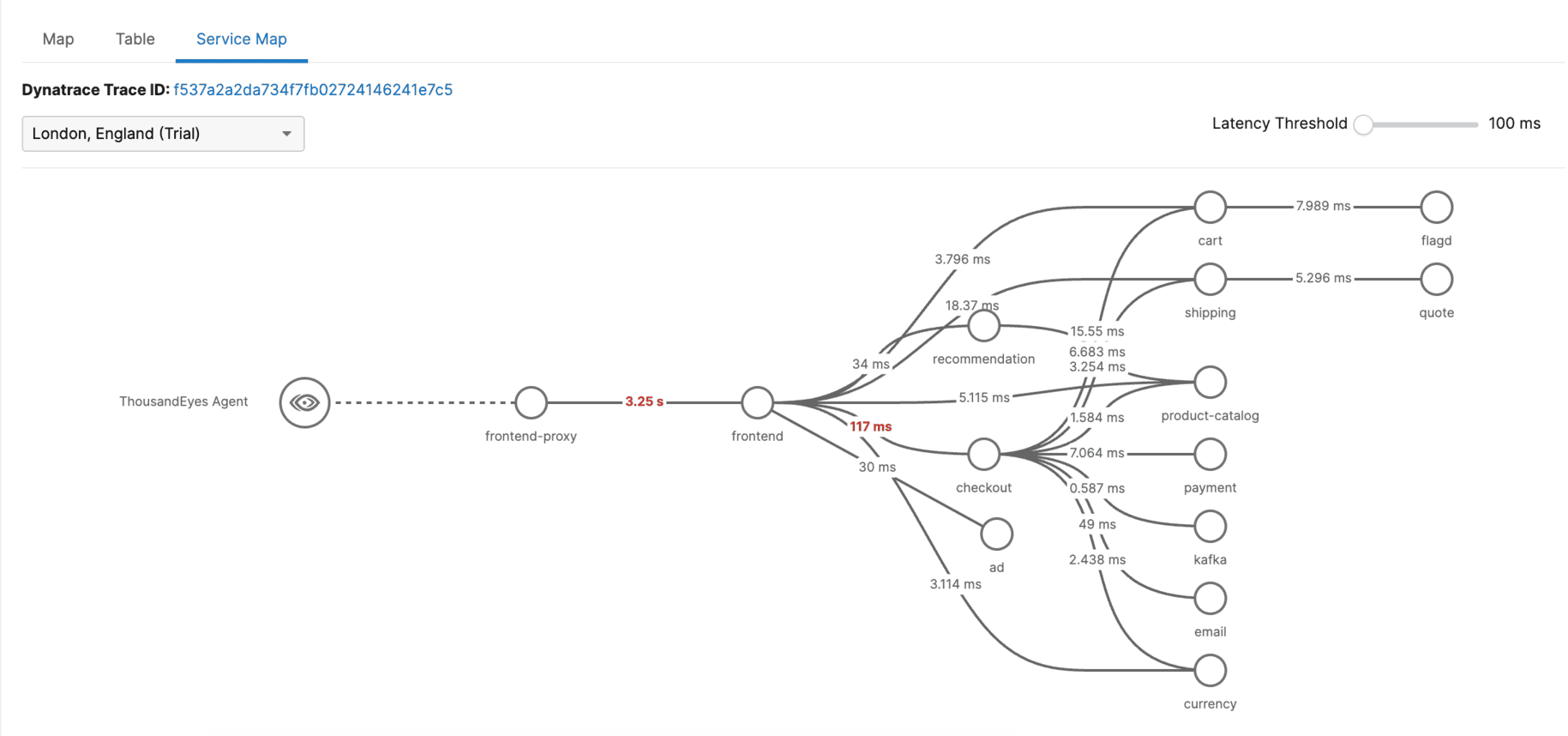
ThousandEyes provides integrated distributed tracing for Splunk Observability Cloud and the Dynatrace® Platform, connecting those backends directly so you can use the Service Map in ThousandEyes to see which services participated in a transaction, where latency or errors appeared, and when to open a deeper trace view in your APM tool—without building custom joins across separate datasets.
Organizations that rely on Dynatrace for APM can:
Correlate network measurements from ThousandEyes tests with service dependencies in the ThousandEyes Service Map, then open the trace in Dynatrace for deeper analysis.
Streamline triaging by running ThousandEyes alerting and dashboards alongside Dynatrace trace data when moving from path-level degradation to application behavior.
Setup requires a Dynatrace Platform Subscription (DPS) license and a platform token with Grail read permissions. All test types supporting distributed tracing are available for this integration, including HTTP server, API, page load and transaction tests. Full configuration steps are in the Dynatrace distributed tracing guide.
Where Teams See the Difference
A single view to triage network and application issues: When a test toward an important endpoint starts to degrade, you can choose to open the Service Map tab in ThousandEyes and review the application path and the network test results in a single view. Scrub the timeline to see how network measurements and service dependencies shifted together, then follow through to your APM platform if you need full trace analysis, with a direct link to the relevant trace.
Bringing Assurance and Observability Together
Cisco ThousandEyes connects network assurance with the observability platform you already use, enriching attribution in both directions across the entire service delivery chain. For teams centered on observability, ThousandEyes adds network and service-delivery context when your APM platform alone cannot separate application behavior from everything between the service and the user. For teams centered on assurance, application trace context from platforms enriches what ThousandEyes shows once traffic reaches your stack. That is not just a more complete view—it is two disciplines that are stronger together. To learn how these integrations fit your observability stack, contact us.
Learn more
Distributed Tracing with Splunk Observability APM
Distributed Tracing with Dynatrace® Platform
ThousandEyes for OpenTelemetry
Cisco and the Cisco logo are trademarks or registered trademarks of Cisco and/or its affiliates in the U.S. and other countries. To view a list of Cisco trademarks, go to this URL: www.cisco.com/go/trademarks. Third-party trademarks mentioned are the property of their respective owners. The use of the word partner does not imply a partnership relationship between Cisco and any other company.